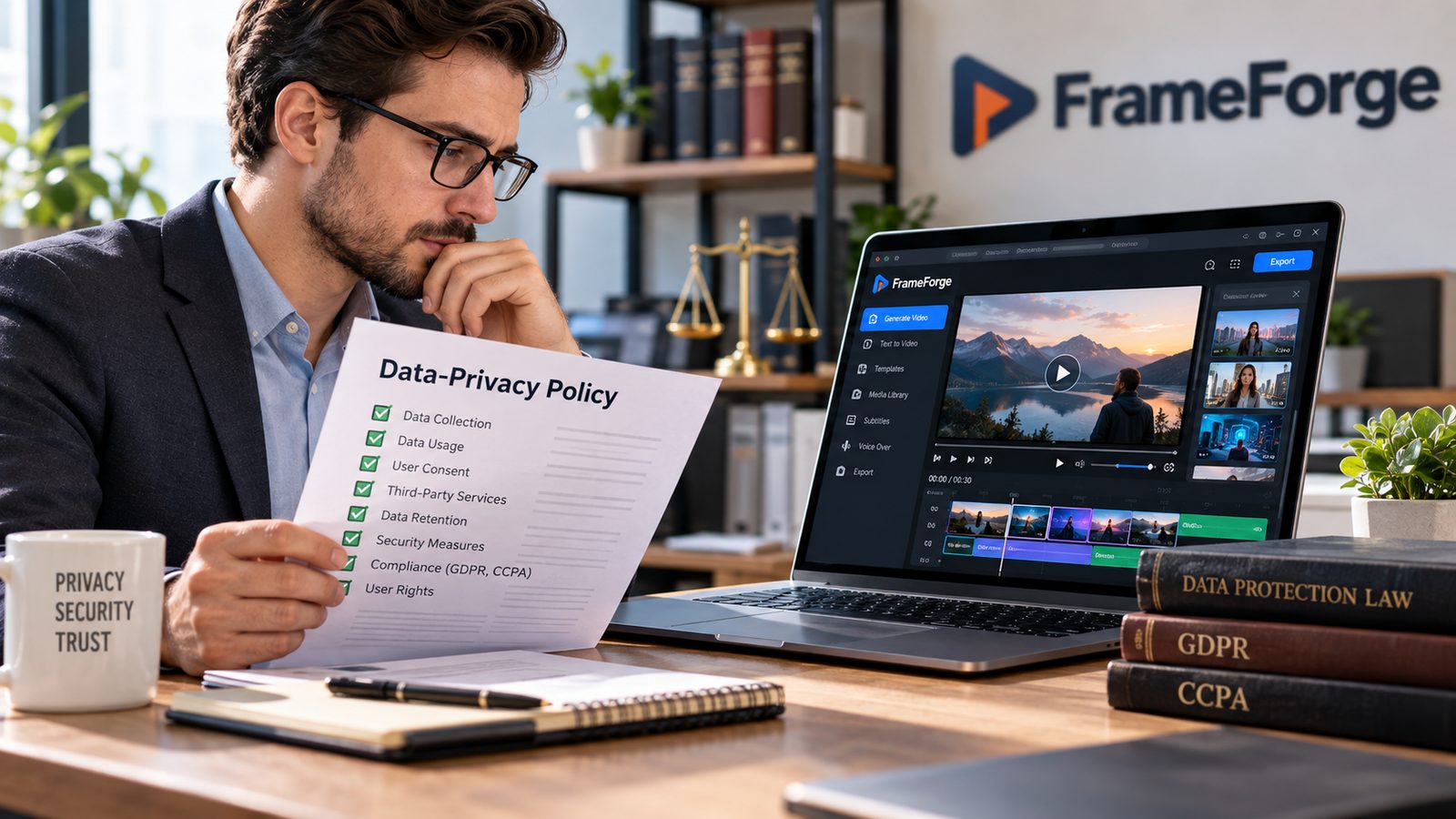
Discover if you need an ai video generator data privacy policy, compliance steps, and common pitfalls for safe video creation.
Yes, any organization that inputs personal or proprietary information into an AI video generator must have a written data‑privacy policy. The policy outlines what data is collected, how it is processed, stored, and shared, and ensures compliance with regulations such as GDPR, CCPA, and industry‑specific rules.
Most jurisdictions require a formal privacy policy whenever you submit user‑generated content, metadata, or voice commands to a generative video AI. Without it, you risk legal exposure, loss of trust, and potential fines for mishandling personal data.
In my practice at FrameForge, I draft policies that specifically address the data flow from input prompts to the final rendered clip. The document clarifies whether the service stores raw prompts, generated frames, or analytics, and it defines retention periods. By making these details explicit, clients can audit the workflow and verify that the AI platform adheres to the stated privacy commitments.
AI video generators typically capture the text prompt, any uploaded images or audio, usage logs, and sometimes device identifiers to improve model performance. Rarely, they may retain generated footage for future training unless you opt‑out.
I have found that many providers bundle analytics with the core service, sending usage statistics to third‑party cloud buckets. To protect privacy, ask the vendor for a data‑processing addendum that lists each data element, its storage location, and the encryption standards applied. When the policy explicitly forbids repurposing raw prompts for unrelated models, you safeguard both client confidentiality and intellectual property.
Compliance hinges on three actions: (1) map all data inputs, (2) secure explicit consent before any personal information is processed, and (3) provide a clear opt‑out and deletion mechanism for the generated content.
After working with several European marketing agencies, I incorporate a consent checkbox that references the ai video generator data privacy policy and links to a “right‑to‑erase” form. The policy must state the legal basis for processing—usually legitimate interest or contractual necessity—and detail cross‑border transfer safeguards, such as EU‑US Privacy Shield or Standard Contractual Clauses.
Personalized ads are allowed if the underlying data is anonymized or if you have documented consent for each individual featured in the video. The policy should cover how voice‑overs, facial imagery, and demographic tags are handled.
In my workflow, I first strip identifiers from the source text, then feed only the abstracted persona description into the model. This approach satisfies both GDPR’s data minimization principle and CCPA’s requirement to avoid “selling” personal data. When you need to display a real user’s likeness, obtain a signed release and note it in the ai video generator data privacy policy.
Typical errors include: neglecting to update the privacy policy after a platform upgrade, assuming default vendor clauses are sufficient, and overlooking the storage of intermediate assets such as raw screenshots or audio snippets.
I often see teams forget to disable “auto‑save” features that retain every prompt in a cloud log. The resulting dataset can be subpoenaed, exposing sensitive business ideas. A robust policy mandates regular audits, disables unnecessary logging, and requires vendors to certify that no training data is harvested without explicit permission.
An AI video generator uses machine learning video synthesis to turn text, images, or audio into moving clips. Prompt engineering for video guides the model, which then renders frames sequentially, applying deep learning video tools to create smooth motion.
Yes, many creative AI platforms now support 4K AI video rendering, though higher resolutions demand more GPU memory and may increase processing time on cloud‑based services.
The top choice varies by budget, but platforms that combine automated video production with built‑in voiceover and subtitle options—such as Synthesia or Pictory—are favored for fast‑turn marketing reels.
Pricing ranges from free trials to subscription plans between $30 and $300 per month, with enterprise licenses adding per‑minute rendering fees for high‑resolution or bulk projects.
Ownership depends on the service’s terms; many providers grant full rights to the user. For detailed guidance, see are ai generated videos copyrighted.
Most modern tools include AI‑driven voiceover synthesis and automatic subtitle generation, allowing creators to produce complete localized videos without external editing.
Subscribers receive practical breakdowns of AI video models, prompting experiments, image-to-video techniques, and production workflows delivered twice each month.
Browse All Guides →