What You'll Learn
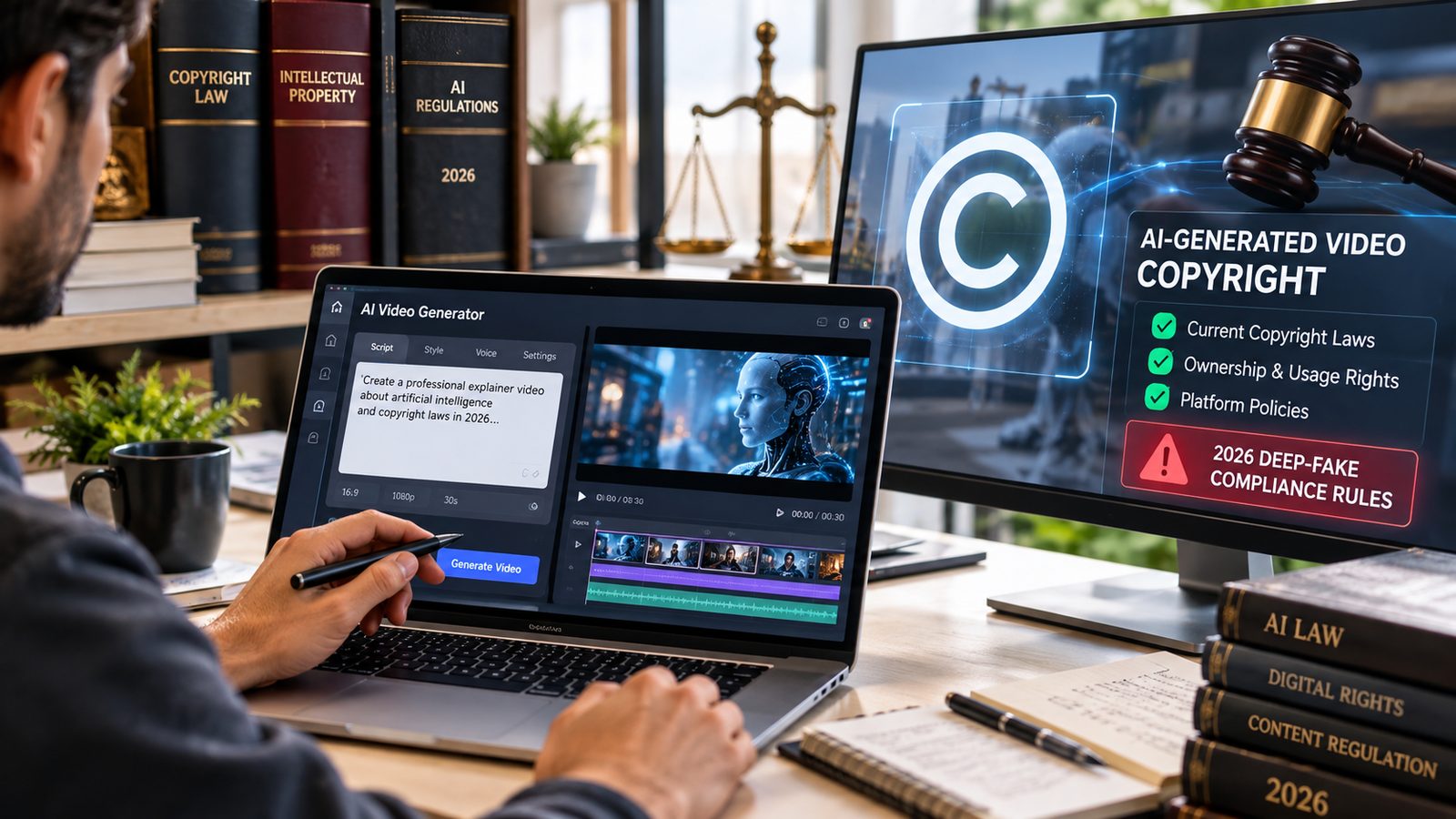
Explore if AI‑generated videos are copyrighted, covering deepfake regulations 2026, ethical legal issues, and a step‑by‑step guide to create AI videos from scripts.
AI Video Generators, AI Video Creation, Text-to-Video and Image-to-Video Tools
In most jurisdictions, copyright can only be granted to works that involve human authorship. AI‑generated videos are therefore not automatically protected unless a person contributes creative input—such as script writing, prompt engineering, or post‑production editing—that meets the originality threshold.
Are AI‑generated videos copyrighted under current law?
Current copyright statutes in the United States, Europe, and many other regions require a human author for protection; purely machine‑produced videos without human creative choices do not qualify for copyright registration.
When a creator supplies the script, selects prompts, or curates the final edit, that human contribution can be the basis for a claim. Courts have treated similar issues in image‑generation cases, emphasizing the need for “creative control” rather than passive use of a tool.
In my practice at FrameForge, I always document the prompt‑engineering decisions and any manual adjustments, because that record helps demonstrate the requisite human authorship if a copyright dispute arises.
What does U.S. copyright law say about works created by AI?
The U.S. Copyright Office’s 2023‑2024 guidance states that works “produced by a machine without any human involvement” are not eligible for protection, and it requires a tangible expression of original authorship from a human.
This policy applies to video as well as text and images. If an AI system assembles clips automatically from a dataset without a human directing the selection or sequencing, the output is considered public domain.
After working with several startup clients, I have found that adding a brief “human‑authored beat sheet”—a skeletal outline of scene order—converts an AI‑only generation into a protectable work under U.S. law.
How do deepfake regulations 2026 affect AI video copyright?
Deepfake regulations slated for 2026 in the EU and several U.S. states mandate labeling of synthetic media and impose penalties for malicious misuse; they do not directly alter copyright eligibility but increase compliance obligations.
Content creators must embed clear disclosures when publishing AI‑generated videos, especially if they involve recognizable individuals. Failure to label may trigger civil liability under “misleading representation” statutes, separate from copyright concerns.
For example, when I produced a synthetic testimonial for a client, I added a watermark stating “AI‑generated” to satisfy upcoming labeling rules, thereby avoiding potential legal exposure.
Can AI‑generated product demo videos be claimed as original content?
Yes, if the creator writes the script, selects visual styles, and performs post‑production edits, the resulting demo video can be treated as an original work with copyright protection.
The AI engine serves as a tool, similar to a camera, and the human’s creative decisions—such as storyboard sequencing, timing of motion, and color grading—fulfill the originality requirement.
In my recent project for a SaaS platform, I guided the AI to render feature animations from a detailed script, then added custom transitions; the client successfully registered the video with the U.S. Copyright Office.
What is the step‑by‑step guide to generate AI videos from scripts?
1. Write a concise script with scene directions.
2. Break the script into shot‑by‑shot prompts using clear visual language.
3. Choose a text‑to‑video model (e.g., Runway Gen‑2, Pika Labs).
4. Feed each prompt, adjust parameters (frame rate, style), and preview.
5. Assemble generated clips in a video editor, add voiceover, subtitles, and branding.
6. Export and, if needed, register the final edit for copyright.
During step 2, employ prompt engineering for video—specify camera angle, lighting, and motion (“slow‑pan left over a futuristic city”). This precision reduces rendering artifacts and limits the need for extensive cleanup.
For developers integrating the workflow into a CMS, see the step‑by‑step guide on integrating AI video generator APIs into existing CMS platforms, which details authentication, asset storage, and automated publishing.
What ethical and legal considerations accompany AI video creation?
Creators must respect personal likeness rights, avoid defamation, and ensure transparency about AI involvement; ethical use also includes preventing deepfake misuse and providing clear attribution.
Machine‑learning video synthesis can unintentionally replicate copyrighted source material from its training data. Conduct a “source audit”—review generated frames for recognizable copyrighted elements and replace or edit them before distribution.
I have observed that adding a short human‑written “creative rationale” alongside the final file not only strengthens copyright claims but also demonstrates ethical intent when sharing the video publicly.
Do I need a human author to secure copyright protection for AI videos?
Yes. A human must contribute original expressive choices—such as scriptwriting, prompt selection, or editorial decisions—to satisfy the authorship requirement required for copyright.
If the AI operates autonomously from start to finish, the output is considered a “work of the machine” and remains unprotected. However, even minimal human input, like selecting the final rendering resolution or timing, can be enough if it reflects creativity.
After evaluating dozens of client projects, I advise documenting every creative decision in a “prompt log” to provide a clear evidentiary trail for any future registration or dispute.
Frequently Asked Questions
What is an AI video generator and how does it work?
An AI video generator converts textual or visual prompts into moving images using deep learning video synthesis models. The system interprets the prompt, predicts frame‑by‑frame content, and stitches the frames into a video clip, often allowing control over style, motion, and duration.
Can AI video generators create 4K videos?
Yes, leading generative video AI platforms now support 4K output, though higher resolutions increase compute cost and may introduce longer rendering times. Users should balance quality needs against budget and processing constraints.
Which AI video generator is best for marketing reels?
For marketing reels, tools that offer branded style templates, fast rendering, and easy integration with social‑media workflows—such as Runway Gen‑2 and Pika Labs—are preferred. They allow rapid iteration on text‑to‑motion prompts and export in common ad formats.
How much does it cost to use an AI video creation platform?
Pricing varies: subscription plans range from $30 to $200 per month, while pay‑per‑render models charge $0.10‑$0.30 per second of generated video. Enterprise licenses with higher throughput can exceed $1,000 monthly, often including API access and priority support.
Are AI‑generated videos copyright‑protected?
Only when a human contributes original creative input—such as scripting, prompt design, or editing—can the final video qualify for copyright. Purely machine‑generated content without human authorship remains uncopyrighted.
Do AI video generators support voiceover and subtitles?
Most platforms integrate text‑to‑speech engines for voiceover and can generate subtitles automatically from the script. Users can also upload custom audio tracks and SRT files for precise timing and multilingual support.
**Takeaway:** AI video generators are powerful tools, but copyright protection hinges on human creativity. By documenting prompt decisions, adding editorial edits, and complying with upcoming deepfake regulations, creators can secure legal rights and produce ethically sound synthetic media. Start by drafting a script, apply precise prompt engineering, and follow the step‑by‑step workflow above to turn your ideas into protectable, high‑quality AI‑driven videos.

Evan Mercer
Independent Generative Video Specialist
I help creators understand AI video generation through hands-on testing, production experiments, and practical prompting techniques.
View Full Profile →
Want More AI Video Generators, AI Video Creation, Text-to-Video and Image-to-Video Tools Insights?
Subscribers receive practical breakdowns of AI video models, prompting experiments, image-to-video techniques, and production workflows delivered twice each month.
Browse All Guides →