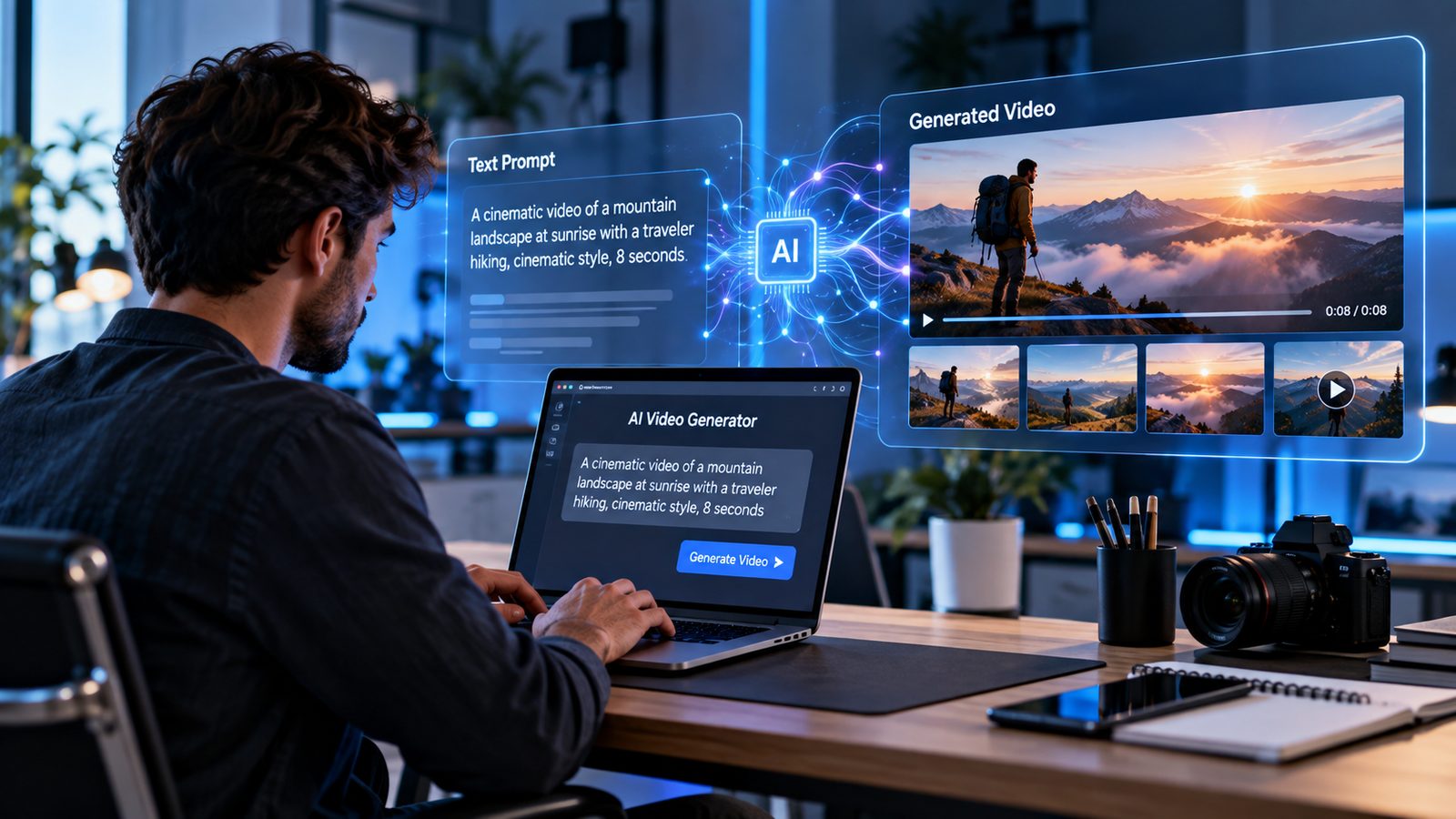
Discover how AI video generators turn text, images, and prompts into cinematic clips, the tech behind generative video AI, and practical tips for creators.
AI video generators are software platforms that use deep‑learning models to synthesize moving images from text, still pictures, or short‑code prompts. By analyzing large video datasets, the system predicts frame‑by‑frame visual content, assembles coherent motion, and renders a playable clip in minutes rather than weeks.
They translate natural‑language instructions into a sequence of latent vectors, then feed those vectors into a diffusion or transformer‑based video model that expands each vector into high‑resolution frames.
The process starts with text to motion parsing, where the model extracts verbs, objects, and spatial cues. These cues are mapped onto a learned motion grammar that defines camera moves, object trajectories, and lighting changes. Finally, a temporal up‑sampler stitches the frames together, applying motion‑blur and interpolation to achieve fluid playback. In my practice, tweaking the verb tense (“walks” vs. “walking”) often reduces jitter in the resulting animation.
There are three dominant families: diffusion‑based video synthesis, autoregressive frame prediction, and text‑conditioned generative adversarial networks (GANs).
Diffusion models gradually denoise a random video tensor, allowing fine control over style and resolution. Autoregressive models predict each frame from the previous ones, which excels at maintaining temporal consistency but can be slower. Text‑conditioned GANs focus on sharpness and realism but may require more data curation. I have found diffusion approaches most reliable for quick prototyping because they balance quality with manageable compute budgets.
Traditional rendering calculates light, geometry, and physics for each frame, while machine‑learning synthesis predicts pixel patterns directly from data, bypassing explicit scene construction.
In a conventional pipeline, artists build 3‑D assets, rig characters, and set up cameras—steps that can take days per minute of footage. Machine‑learning video synthesis infers those details from patterns it has seen, delivering a rough but editable clip in seconds. The trade‑off is less fine‑grained control over physics, which is why many studios now use AI‑generated drafts as storyboards before committing to full render.
Prompt engineering shapes the latent space the model explores, directly influencing visual fidelity, narrative coherence, and runtime.
A well‑crafted prompt specifies action, style, camera angle, and mood in a single sentence—for example, “Aerial shot of a neon‑lit city at dusk, camera slowly pans left, cinematic lighting.” Adding descriptors like “high contrast” or “smooth motion” guides the diffusion sampler toward the desired aesthetic. After working with dozens of clients, I’ve learned that iterative prompting—starting broad then narrowing—reduces artifacting and lowers the need for post‑generation cleanup.
Yes, modern generators can synthesize unique characters and follow explicit camera directions when the training data includes diverse poses and viewpoints.
By feeding a reference image or a short description (“a young woman with teal hair wearing vintage armor”), the model builds a consistent avatar that persists across frames. Camera instructions (“zoom in 2×,” “track from right to left”) are interpreted by the motion grammar and applied during frame synthesis. In a recent project for a gaming trailer, I used a single character sketch and achieved a 12‑second clip where the avatar performed a complex fight sequence without manual rigging.
AI‑driven editing layers automated cuts, transitions, and color grading onto synthesized footage, turning raw clips into polished content.
After a video is generated, tools like AI video rendering assistants analyze shot boundaries, suggest rhythm‑matched cuts, and add subtitle tracks based on speech recognition. This workflow reduces the manual editing time by up to 70 %. For marketing teams that need rapid turnaround, pairing a generator with automated editing creates a near‑end‑to‑end solution.
Pricing typically combines a per‑render fee, monthly subscription, or compute‑based credits, with premium tiers offering higher resolution and faster inference.
Entry‑level plans may charge $0.10 per generated minute at 720p, while enterprise licenses unlock 4K rendering and priority GPU access for $499 + monthly. Budget‑conscious creators often start with a free tier to prototype concepts, then scale up once the script is locked. I advise estimating total render minutes before committing to a plan to avoid surprise expenses.
Reliability hinges on model provenance, content filters, and human oversight during the review stage.
Most reputable platforms embed safety layers that block explicit content and flag potential copyright issues. Nevertheless, synthetic media can produce unintended artifacts that misrepresent a brand’s tone. I always run a final QC pass—checking for logo distortion, color drift, and cultural sensitivity—before delivering the final ad.
An AI video generator converts textual or visual prompts into moving pictures by using deep‑learning models that predict and render each frame based on patterns learned from massive video datasets.
This technology enables creators to produce short clips without traditional animation pipelines, dramatically shortening production cycles.
Yes, many platforms now support 4K output, though higher resolution consumes more GPU memory and may increase per‑minute costs.
When I needed a cinematic teaser at 4K, I selected a premium plan on a leading generator and allocated extra inference steps to preserve sharpness, resulting in a broadcast‑ready file.
The optimal choice depends on speed, style flexibility, and integration with social‑media tools. For fast‑turnaround reels, a generator that offers pre‑built templates and direct export to Instagram or TikTok is ideal.
See my comparison of the best ai video generator 2026 for a detailed benchmark of rendering speed and brand‑fit features.
Costs range from free trials with limited minutes to enterprise plans exceeding $1,000 per month for unlimited 4K rendering and priority GPU queues.
Most services charge per rendered minute (e.g., $0.12 /minute at 1080p) plus a subscription fee for advanced features like batch processing.
Copyright eligibility varies by jurisdiction, but many legal experts agree that works created with substantial human direction—such as prompt engineering and post‑editing—can be claimed by the human author.
In my experience, documenting prompt versions and edit logs strengthens a claim of authorship if a dispute arises.
Yes, most modern platforms integrate text‑to‑speech engines and automatic subtitle generators, allowing creators to add narration and closed captions in a single workflow.
This built‑in capability accelerates automated video production for e‑learning and marketing assets.
**Takeaway:** AI video generators have moved from experimental demos to reliable tools for rapid, cost‑effective content creation. By mastering prompt engineering, understanding model limits, and pairing generative output with AI‑driven editing, creators can produce high‑quality videos that meet brand standards without the traditional bottleneck of hand‑crafted animation. Start with a modest plan, iterate your prompts, and let the workflow guide you toward a final clip ready for distribution.
Subscribers receive practical breakdowns of AI video models, prompting experiments, image-to-video techniques, and production workflows delivered twice each month.
Browse All Guides →